Blog · Part of the Safety and Privacy guide
Building an OnlyFans Persona: How Much of Yourself to Show
How to decide how much of yourself to show on OnlyFans, from fully anonymous to fully yourself, and how to build a persona with boundaries you can keep up.
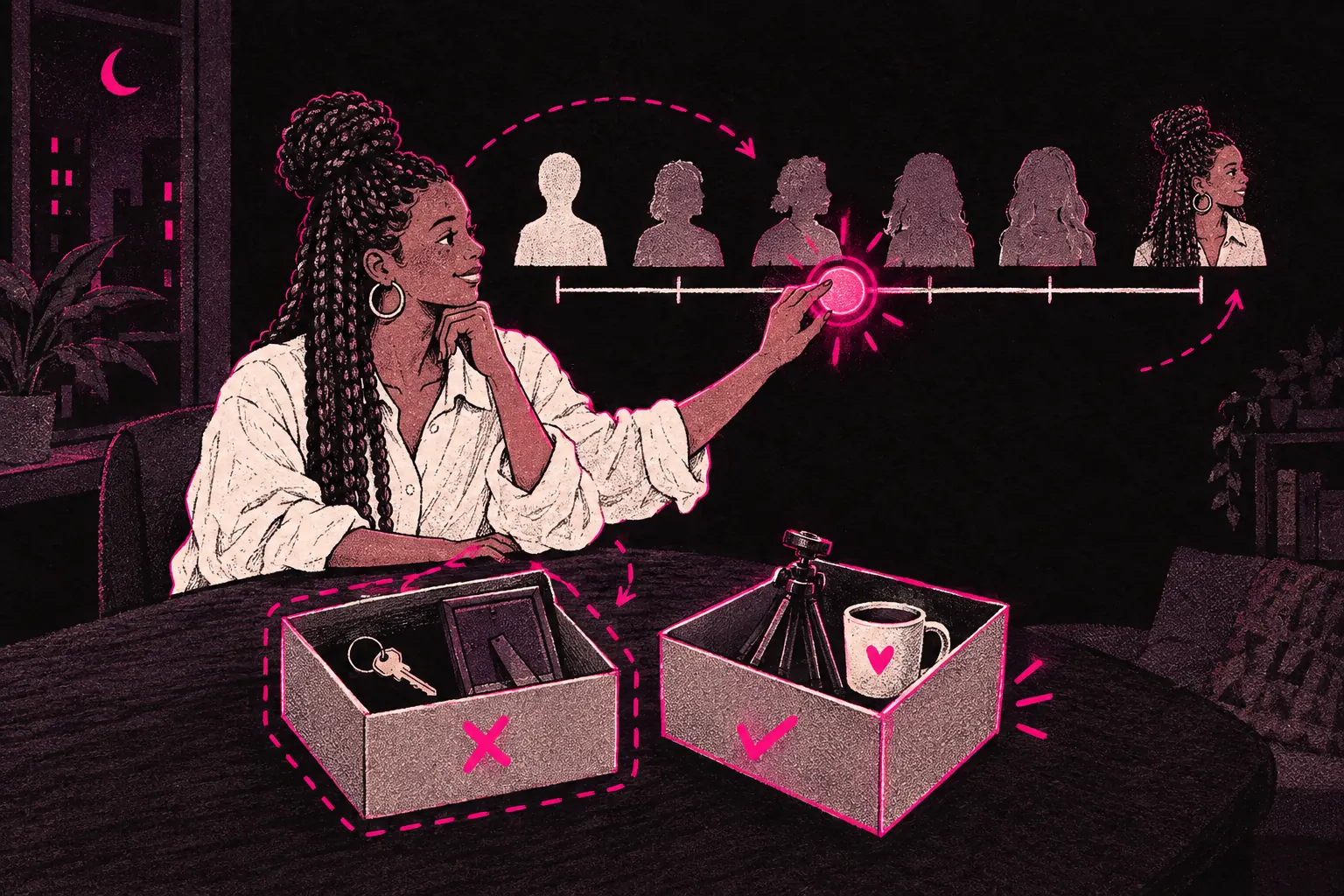
How much of yourself you show on OnlyFans is your call, and there’s no single right amount. What matters is that you decide on purpose before you start, so you don’t slide into it one message at a time.
It’s about more than what’s on camera. Your real name, where you live, your interests, your personality and your life story all count. So where do you draw the line between your creator identity and your private self? That depends on how comfortable you are, what you want from the page, how much risk you can live with and how long you plan to do it. Working through the questions below gives you a way to decide.
The spectrum from anonymous to fully yourself
Don’t think of a persona as a yes-or-no choice. It’s a sliding scale.
At one end are creators who stay as anonymous as they can. They use a stage name, never show their face, share nothing that could identify them, and keep a strict wall between their creator life and everything else. Our post on anonymous OnlyFans creation covers how that works in practice.
At the other end are creators who are completely themselves. Real name, real face, open about their work in daily life, with no split between the two identities. They treat OnlyFans like any other public-facing career.
Plenty of creators sit somewhere in between. They show their face but use a stage name. Their personality comes through, but some details stay private. Subscribers feel they know them, even though they don’t know everything about their life.
How to decide what to share
Start with your non-negotiables
Before you make anything, write down what you’ll never share. That might be your surname, your city, where you work, identifying tattoos, whether you have children, your relationship status, or anything else that feels off limits.
Those are your hard boundaries. A subscriber asking, or more money on the table, isn’t a reason to move them. If you ever do change one, make it a decision you take on a calm day, away from the inbox. Having them written down before you start makes that pressure easier to spot.
Consider your long-term plans
Are you planning to do this for six months or six years? If it’s a short-term way to bring in extra money, heavy anonymity might make sense. If you’re building a brand for the long run, decide how much you’re happy for subscribers to get to know you, because that sense of connection is part of what many fans pay for.
Think about life after OnlyFans too, whenever that comes. What would you be comfortable with if a future employer, a family member or a partner found your content? Nobody’s asking you to be ashamed of the work. You just want to go in knowing what could happen.
Assess your risk tolerance
People draw the line on risk in very different places. For one creator, a colleague finding her page would be mildly awkward. For another, it would be devastating. Be straight with yourself about which is closer to you, and let that decide how much identifying information you share.
Think about your content type
What you make can change how much of your identity you need to share. Some niches depend on closeness, where subscribers feel they’re getting to know a real person. Others lean on fantasy, and there the mystery and distance are part of the appeal.
The difference between a persona and being fake
Building a persona doesn’t make you dishonest or manipulative. You’re choosing which parts of your personality, your looks and your life show up in one particular setting.
Everyone does this. You come across differently in a job interview than you do with close friends. You share different things on LinkedIn than you do at the pub. A persona just means making that choice on purpose for your creator work.
It matters for a few reasons:
- A persona built from real parts of your personality is one you can live with. A character you’ve made up from scratch can wear you out, and it’s hard to hold together for long.
- Subscribers often notice when someone’s putting on an act. Sharing real parts of yourself, while keeping others back, builds trust. An act they can see through loses it.
- It’s easier to stay creative and keep turning up when you’re drawing on who you are, with no made-up story to keep straight.
How a persona protects you
Emotional buffer
Putting content out there opens you up to judgement, criticism and sometimes cruelty. A persona puts some distance between those reactions and your sense of who you are. A nasty comment aimed at your creator identity can be easier to shrug off than one that feels like an attack on you as a person.
You can still care about your subscribers and enjoy the work. The persona just gives you a healthy line between the job and the rest of your life.
Privacy preservation
When you’ve decided in advance which details stay private, it’s easier to be friendly and chatty without giving away something that could put your safety at risk. You can be warm and funny with subscribers and still keep the truly private things private.
Boundary enforcement
When subscribers push for personal information or try to cross a line, a clear persona makes it easier to steer the chat somewhere else. “That’s not something I share” is easier to stick to when you’ve already decided what’s in and out of bounds for your creator identity.
Professional longevity
Platforms change. Algorithms shift. Your life changes too. A persona gives you room to move. If you need to change direction, take a break or stop altogether, a creator identity that’s partly separate from your real one can make that easier.
Building a persona that is sustainable long-term
Root it in truth
Build your persona around traits you already have, turned up a notch. If you’re naturally funny, lean into it. If you’re the caring type, build on that. If you’re confident, let it show. Your persona should feel like you on a good day. It shouldn’t feel like a part in a play.
Keep it simple
The more complicated your persona, the harder it is to keep it steady. If it depends on remembering a detailed made-up backstory, you’ll contradict yourself sooner or later. Simple is much easier to keep going.
Document your boundaries
Write down your persona’s rules. What does this version of you share? What doesn’t she share? How does she reply to certain kinds of messages? Which topics are fine, and which are off the table?
This is especially useful if you ever work with a management agency or someone who handles your messages. At TalentGrow, your limits are written into the contract and recorded on a model information sheet the chat team works from, and you can go through them on the video call before you sign. Written rules make it far easier for whoever chats as you to match your communication style without crossing a line you’ve set.
Allow it to evolve
Your persona doesn’t have to stay fixed. People change, and your creator identity can change with you. Just make changes gradually and on purpose. Subscribers notice a sudden switch in personality or style, and it can throw them.
Protect your energy
Keep an eye on how playing your persona feels over time. Some days will be harder than others. But if it feels draining week after week, like a weight you can’t put down, change something. That might be what you share, how often you chat or how much of the persona is an act.
Practical steps to define your persona
1. List your real personality traits
Write down five to ten words that describe you. Skip the qualities you wish you had. Pick real ones that people who know you would recognise.
2. Choose which to amplify
From that list, pick the three or four that best fit the brand you want and the audience you want to attract. They become the core of your persona.
3. Define what stays private
Separately, list what you keep to yourself. Keep that list somewhere you’ll see it, so you can check what you decided when a subscriber pushes.
4. Create your communication framework
Using the traits you picked, write a few sample messages in your persona’s voice. How does this version of you welcome a new subscriber? How does she take a compliment? How does she promote a new post? Keep these to hand. They keep you sounding like the same person on days when you’re tired or distracted.
5. Test and refine
Your first version doesn’t have to be your last. Post, chat to subscribers, and notice what feels natural and what feels forced. Then adjust.
When to seek support
Building and keeping up a persona while you run a business, make content and look after subscribers is a lot to carry on your own. If it’s getting too much, or you’d like help thinking your brand through, a management team can take some of that weight off you.
TalentGrow accepts faceless and body-only pages as well as creators who show their face, and the boundaries you set stay yours. It’s month to month with no lock-in and no exit fees, on 14 days’ notice, so there’s no pressure to commit before you’re ready.
If that sounds useful, you can apply here.
Choosing a persona you can live with
Your persona decides what people see without making you show everything. Aim for one that’s close enough to the real you that you can keep it up, inside boundaries you picked yourself.
Think it through before you start, and come back to it now and then as your page grows. You’re looking for a version of yourself you can be week after week without burning out or losing track of who you are.