Blog · Part of the Agencies and Management guide
OnlyFans Agency Scams and Red Flags to Spot Before You Sign
The six OnlyFans agency scams, nine red flags that show up before you sign, how to check an agency is legitimate and what to do if you've been scammed.
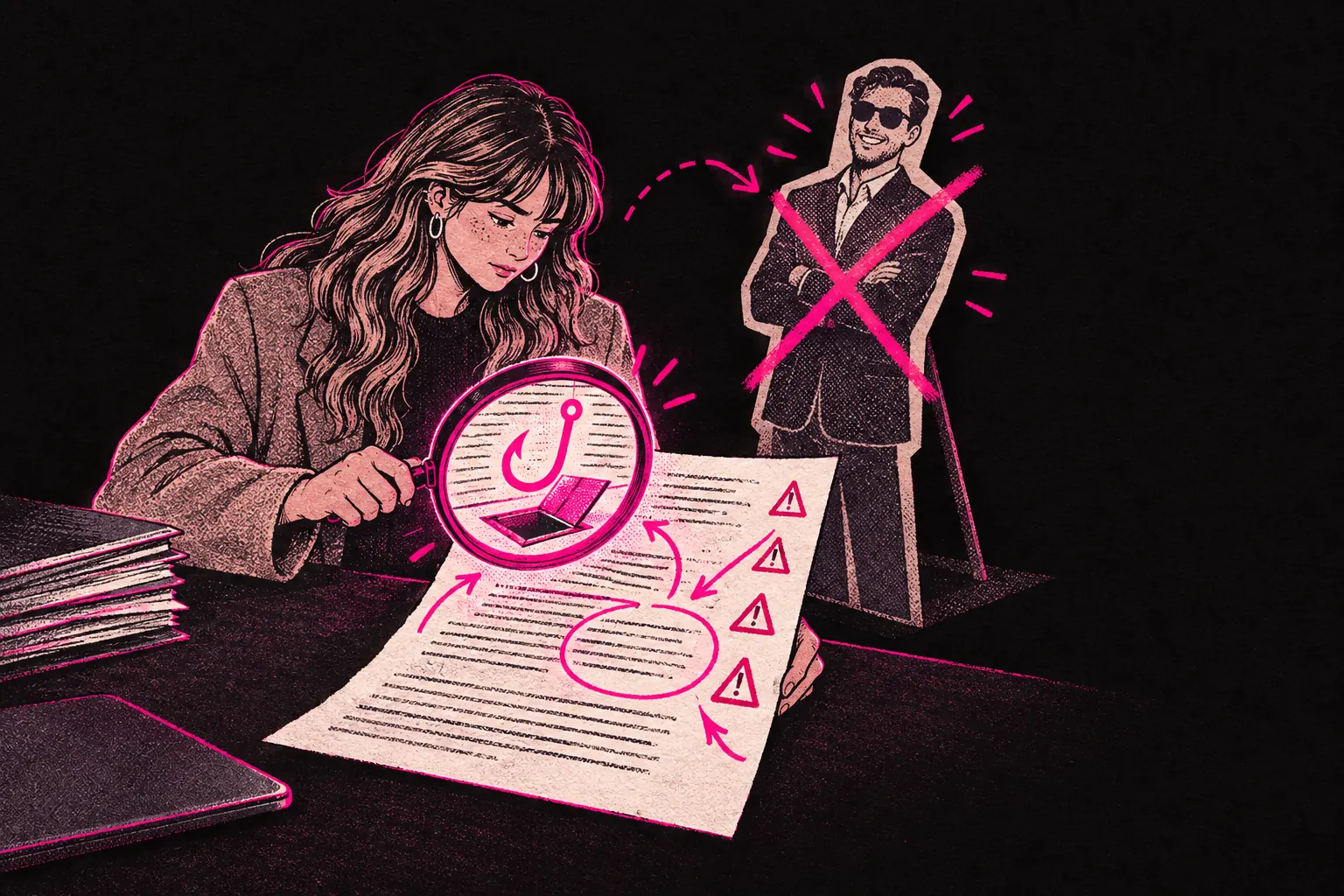
OnlyFans agency scams tend to fall into six patterns, and you can often spot the warning signs before you sign anything. Check who owns the account, where the payouts go, what the contract ties you into, and whether the company will give you its registered details.
Creator management has grown fast, and scammers have followed the money. Most of them aren’t clever. They count on you being new, not knowing how a proper agency works, and wanting growth badly enough to skip the checks. Below are the outright scams first, then the red flags that should make you slow down, ask harder questions or walk away.
The six common scam patterns
1. Account ownership theft
Losing your account is one of the hardest things to recover from. The agency asks you to register the account with their email address, or to hand it over to them outright. Once it’s theirs, they control your earnings, your subscribers and your content. Some change the password and lock you out. Others are quieter about it, switching the payout details to their own bank account and telling you there’s a “processing delay.”
A management team does need access to your account to run chat, posting and promotion. Access and ownership are different things. The account should always be registered in your name, with your email address and your bank details, and you should be able to change the password and remove the agency’s access whenever you want. Be wary of an agency that wants access but won’t put in writing what it can reach, what it never touches and how you remove its access.
2. Upfront fee scams
Most management agencies earn an agreed share of your revenue, so they get paid when you do.
Scam agencies charge upfront instead. They call it an “onboarding cost”, a “setup fee”, a “marketing deposit” or a “portfolio creation charge”. Once they’ve got your money, the service either never turns up or turns out to be worthless. Once they’ve been paid, you’re left chasing them if nothing happens.
If an agency wants money before it’s done anything for you, walk away.
3. Guaranteed income promises
No agency can guarantee what you’ll earn. Anyone who says otherwise is lying or doesn’t understand the industry. Your earnings depend on your niche, your content, your audience, the market and plenty of other things no agency controls.
Lines like “we guarantee you’ll earn six figures” or “every creator on our books makes at least X a month” are there to get you excited and stop you thinking it through. Treat a guarantee as a reason to leave.
4. Content theft operations
Some outfits calling themselves agencies don’t want to manage anything. They want your content. They ask for photos and videos as part of “onboarding”, or for your content library “for marketing”. Once they’ve got it, they vanish, then post it on other sites, sell it, or keep it to threaten you with.
Don’t send content to anyone you haven’t checked out thoroughly. Even then, share it through a secure method you’ve both agreed on, and never as DMs or email attachments to someone you first spoke to last week.
5. Social media recruitment scams
You’ve probably had the DMs. “We love your content, you’ve got huge potential, we’d love to manage you.” Messages like these land in creator inboxes on Instagram, X, TikTok and Reddit all the time. Some come from real agencies. Plenty don’t.
Scam recruiters often use fake profiles, stolen logos and made-up testimonials. They invent urgency with “limited spots” or a “special rate” that’s about to run out. “This offer is only available today.” “We need your decision by Friday.” A good agency is happy for you to take the contract away, read it, sleep on it or show it to a solicitor.
If someone’s rushing you, that alone is a reason to slow down. An agency worth working with will still be there next week.
6. Agencies that disappear after signing
This one hurts because it looks legitimate at first. There’s a website, a contract and a pitch that sounds reasonable. You sign, the split starts, and for a while everything seems fine. Then the replies slow down and messages go unanswered. The marketing and growth work they promised never quite happens, and by the time you notice, you’ve been paying for months.
Your best protection is a month-to-month contract with a clear notice period, so you can leave quickly if it isn’t working. Ask for regular written reports too, and check them against the work you were promised.
Nine red flags that show up before the scam
Not every bad agency is running a scam. Plenty just run a model that works far better for them than for you. These signs help you spot both kinds before you’ve signed.
1. They want ownership of your account, or access with nothing in writing
This is the one that can do the most damage. If an agency owns your account and things go wrong, you’ve nothing to bargain with. You could lose your subscribers, your content and your income overnight.
A proper setup looks like this. The account’s in your name, OnlyFans pays you directly, and the agency invoices you for its percentage after you’ve been paid. The agency will need access to run the page, so get in writing what it can reach, what it never touches and how you remove that access. If the relationship ends, you change the password and keep everything you built.
2. Long lock-in contracts
Six months. Twelve months. Sometimes longer, with penalties for leaving early. Contracts like that make it hard to walk away if the service isn’t what you were promised. Look for rolling month-to-month terms with a clear notice period, usually 30 days, where either side can leave without a penalty. Our contracts guide covers what the rest of a fair agreement looks like.
3. Vague or shifting pricing
If you ask about the split and get confusing tiers, undefined targets or “we’ll work it out as we go”, be very careful. The percentage should be written plainly in the contract, along with whether it’s taken from gross or net earnings. Put a few different splits into a pricing calculator to see what each one means at your income. A 40% cut looks very different at different earning levels.
4. Pressure to sign quickly
This came up under recruitment scams, but it gets its own line because agencies that look legitimate do it too. If someone’s pushing you to commit before you’ve had time to think, ask yourself what they don’t want you to notice.
5. No references or proof of results
Ask what they can show you. That might be earnings statements with the names removed, examples of their work, or a creator who’s happy to talk to you. Privacy is a fair reason not to name clients, but it doesn’t stop an agency showing you anything at all. If all you get is vague talk about results, be careful.
6. They push you to create content you are uncomfortable with
A good agency asks early on what you will and won’t do, writes it down and sticks to it. If an agency calls your limits a problem, or says an uncomfortable request is just “what sells”, that’s pressure dressed up as business advice. Any plan to grow your earnings should work within your limits.
7. No clear communication schedule
How often will you hear from your manager? How quickly will they reply? Which channels will they use? If none of that’s agreed before you sign, you’ve nothing to hold them to afterwards. A good agency sets this out early, with regular check-ins, a reporting schedule and a reply time agreed in writing.
8. Taking a cut of existing income without a plan to grow it
Many agencies take their percentage of everything the page earns, including income you already had before they arrived. That’s a normal way to charge, but it means the agency has to grow your earnings before you’re any better off. If you keep 60%, your earnings need to rise about 1.7x just to break even. At 50% they need to double, and at 40% they need to rise about 2.5x.
Ask when the split starts and what it applies to. Then ask exactly what they’ll do to grow the page. If they can’t give you a concrete plan, you’d be paying them a share of money you were already making.
9. They hide their team or location
If you can’t find out who runs the agency, where it’s based or who’ll be working on your account, take that seriously. An operator with no registered business and no footprint online is a risk you don’t need. Ask for the company’s registered details and where the team works. A real agency will tell you, and it’ll meet you on a video call.
What a good agency actually looks like
For comparison, this is what a healthy arrangement looks like.
- The account stays in your name, and OnlyFans pays your earnings into your bank. The agency invoices you for the agreed split.
- The agency has the access it needs to do the work, and you can change the password and end that access whenever you want.
- The contract’s month to month. Either side can leave with reasonable notice and no penalties.
- The split is clear and fixed, written plainly in the contract with no hidden fees.
- You know when to expect updates and how to reach whoever runs your account.
- What you will and won’t do is agreed at the start and respected throughout.
- They can show you some proof of results.
- They’ll give you their registered company details and tell you where they’re based.
If you’re still not sure you need management at all, read the signs you might need an agency first. Not every creator does.
How to verify an agency is legitimate
Run through this checklist before you sign anything.
- Ask for the company’s registered details. UK companies are listed on the public register at Companies House, so you can check the details match who you’ve been talking to.
- Look for a real online presence. That means a proper website with useful information, guides or resources that show they know the industry, and social accounts with real activity beyond promotional posts.
- Ask who owns your account. The answer should always be you. If they hesitate or add conditions, don’t sign until it’s clear in writing that the account is yours.
- Ask what access they need and why. Get in writing what they can reach, what they’ll never touch and how you remove their access.
- Read the contract, every clause of it. If you don’t understand something, ask. If the answer doesn’t satisfy you, get a solicitor to look at it. A legitimate agency won’t mind.
- Ask about the notice period. You should be able to leave with reasonable notice, usually 30 days, and no penalties.
- Ask for proof of results. Earnings statements with names removed, examples of their work, or a creator who’ll talk to you are all fair things to ask for.
- Check where the money goes. Your earnings should reach your bank first, and the agency should invoice you for its share. If the money goes the other way, don’t sign.
- Ask everyone the same questions. We keep a list of the questions to ask any agency on the first call, and that includes us. Watch how they answer as well as what they say.
If you’d like to see how our setup works, how we structure our management sets it all out.
What to do if you have been scammed
If you think a scam agency’s got you, move quickly.
- Secure your accounts. Change your passwords and the email address on the account, check your bank details haven’t been changed, and turn on two-factor authentication everywhere.
- Keep a record of everything. Save every message, email, contract and screenshot. You’ll need them if you report it or take legal action.
- Report it. In England, Wales and Northern Ireland, report fraud to Report Fraud, the national service that replaced Action Fraud. In Scotland, report it to Police Scotland. If your content’s been stolen and shared, contact the site it’s on and send a DMCA takedown notice.
- Get legal advice. Some solicitors offer a free first consultation. If you were misled into signing a contract, you may be able to get out of it.
- Warn others. Creator forums and communities are one of the best defences against scams. If you’re comfortable sharing what happened, it could stop someone else falling for the same thing.
Trust the paperwork, not the pitch
A legitimate agency makes money when you do. It doesn’t need an upfront fee, ownership of your account or a rushed signature to get paid. A lot of the worst outcomes start with a contract signed too quickly by someone who didn’t know what to check.
So read every contract, ask your questions and take your time. If something feels off, listen to that.
To see how we run things, have a look at how we operate. If you’d like to talk about working together, you can apply here. A person replies to applications within 24 hours, and you’ll have a video call with us before you sign anything.