Blog · Part of the Safety and Privacy guide
How to Stay Anonymous on OnlyFans: A Complete Privacy Guide
Practical steps to protect your identity as an OnlyFans creator, from payment privacy to metadata removal and social media separation.
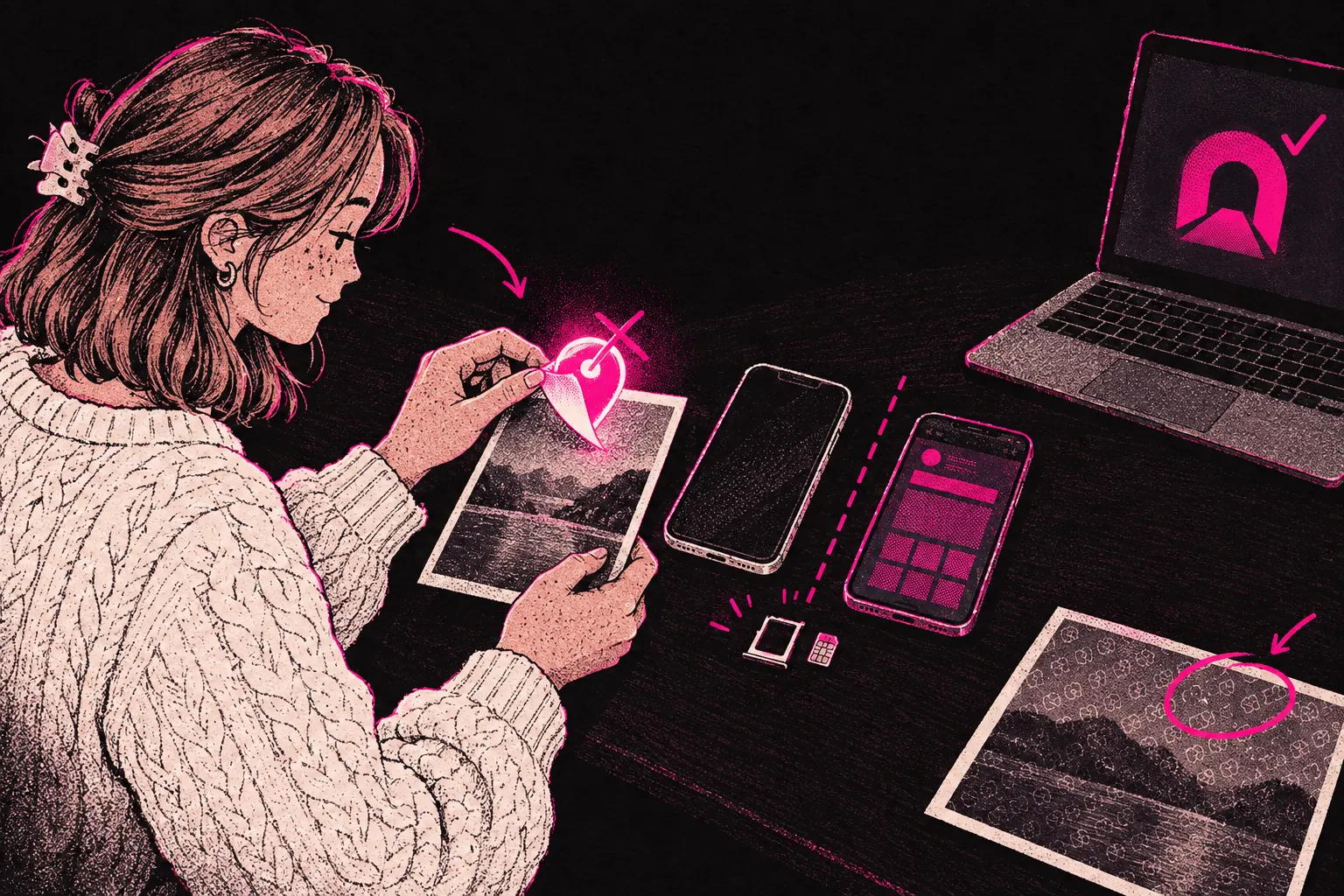
Yes, you can stay anonymous on OnlyFans, but you have to plan for it from day one. Once your personal details are out there, getting them back is extremely hard.
It’s one of the first things new creators ask about. Below are the steps that matter, from your stage name and email to payments, metadata, social media and what to do if someone finds out.
Why anonymity matters
You might have a career alongside your creator work, or family who wouldn’t understand. You might just value your privacy. Either way, the rule is the same: keep your creator identity and your personal identity completely separate. Anywhere the two overlap, someone could connect them.
Set it up carefully and it’s possible to build a successful page without anyone in your personal life knowing.
Choose a stage name and stick with it
Your stage name shouldn’t be a version of your real name, a nickname your friends use or anything a quick search could trace back to you. Pick something distinctive enough to remember but ordinary enough that it doesn’t narrow down who you are. Search for it online before you commit, and make sure nothing connected to the real you comes up.
Once you’ve chosen it, use it everywhere: every platform, every email and every conversation.
Separate email and phone number
Set up a brand new email address in your stage name. Don’t use your personal Gmail or iCloud account. ProtonMail is a good choice because it offers end-to-end encryption and often doesn’t need a phone number to sign up.
For phone verification, get a second SIM or use a virtual number service. You don’t want your personal number attached to anything connected to your creator work. In the UK, a pay-as-you-go SIM costs a few pounds.
Use that email and phone number for everything to do with your creator work.
Payment privacy
This part catches a lot of creators out. OnlyFans pays into a bank account in your legal name, and you can’t change that. But subscribers never see the name on your bank account. Fans only see your display name, and your legal details stay between you and the platform.
It’s worth opening a separate bank account just for your creator income. It keeps your money apart and makes your accounts simpler. The tax calculator helps you keep track of what you owe as your earnings grow.
If you register as a sole trader later, you can trade under a business name that isn’t your own. A limited company is different. Its name and its directors’ names are on the public register at Companies House, so naming a company after your stage name could link that name to the real you.
Strip metadata from your content
Every photo and video carries hidden data called EXIF metadata. That can include GPS coordinates, your device model, the date and time, and sometimes your name if your device is set up that way. Upload without removing it, and anyone with basic technical knowledge could pull out your location and device details.
Remove the metadata before you upload anything:
- On iPhone, use an app like Metapho or Photo Investigator.
- On Android, try Scrambled Exif or Photo Metadata Remover.
- On a computer, ExifTool strips metadata from lots of files at once. ImageOptim (Mac) or GIMP (Windows) let you do it with buttons instead of commands.
Make it part of your routine. Nothing should go near a platform until the metadata’s gone.
Keep location details out of your content
Metadata isn’t the only thing that can give away where you are. What’s in the shot can too.
Watch your backgrounds
A window showing a recognisable street, landmark or sign is an obvious giveaway. Less obvious are distinctive wallpaper, a view from a particular angle, or a delivery box with your postcode on it.
Be careful outdoors
If you shoot outside, pick places people can’t easily identify. A generic park is fine. The spot next to a well-known local pub isn’t.
Turn off location services
Switch them off on any device you use for creator work, so your phone doesn’t tag photos and videos with your location automatically.
Don’t post in real time
If you’re somewhere recognisable, wait until you’ve left before you post. Posting while you’re still there gives people a chance to find you.
Social media separation
A lot of creators slip up here. Your creator accounts and personal accounts need to be completely separate, with different emails, different phone numbers and different devices if you can manage it.
Don’t follow friends or family from your creator accounts. Platforms use mutual connections to suggest profiles, so if you follow your sister from your creator Twitter, it might suggest your creator account to her.
Don’t reuse username patterns either. If your personal Instagram is “sarah_travels_2024” and your creator Twitter is “sarah_creates_2024”, someone could put the two together.
Say no to contact syncing on any app you use as a creator. If you let it see your contacts, it may suggest your profile to everyone in your phone book.
For more on promoting yourself without giving away who you are, read our guide on social media funnels.
Use a VPN
A VPN (virtual private network) hides your IP address and encrypts your internet traffic, so platforms can’t log where you really are.
Use a reputable paid VPN whenever you log into your creator accounts. Free VPNs often make money from your data. Mullvad, ProtonVPN and NordVPN are all solid choices. It matters most on public Wi-Fi, but it’s good practice at home too.
Watermark your content to trace leaks
Content leaks happen. You can’t stop them completely, but watermarks make it possible to work out where a leak came from.
- Visible watermarks: a small, see-through logo or line of text that puts off casual sharing and shows the content’s yours.
- Invisible watermarks: unique markers hidden in the content that viewers can’t see. Some creators use slightly different crops for different channels, so if content turns up somewhere it shouldn’t, they can tell which version leaked.
At the very least, put a visible watermark on anything you share. A small logo in the corner is enough.
What to do if you are outed
Even if you do everything right, there’s a small risk someone works out who you are. If it happens:
- Try to stay calm. It usually feels worse in the moment than it turns out to be.
- Keep evidence. Screenshot everywhere your information has been shared, with dates, times and links.
- Report it and ask for it to be taken down. Most platforms have rules against sharing someone’s personal information without consent.
- Contact the police if you’re threatened. In the UK, sharing someone’s personal details to harass or frighten them can be a criminal offence. Call 101, or 999 if you feel you’re in immediate danger. Our safety guide goes into more detail.
- Talk to someone you trust. You don’t have to deal with it alone.
Anonymity is a system, not a single step
No one step keeps you anonymous. It’s all of them together. A stage name won’t help if your personal email is attached to your creator account, and stripping metadata won’t help if your living room window shows a street people know.
Set everything up carefully from the start, check your setup every so often, and keep privacy in mind for as long as you’re creating.
If you’d like help setting up your creator identity safely, or you’re already posting and want someone to check your privacy setup, you can see how we work or apply to work with us. The team needs access to your account to run chat, posting and promotion, and you keep full control. The account stays in your name, payouts go to your bank, and you can change the password and end our access at any time. We invoice after you’ve been paid, and there’s no lock-in.